Recognizing Peptide Purity: What 99%+ Truly Implies
A sample might generate a clean-looking chromatogram with one leading height and still be the incorrect compound if identification was never verified. HPLC actions splitting up and family member peak area; mass spectrometry actions mass-to-charge actions that can be used to validate molecular identification. Peptide pureness screening is the process of validating that a peptide example consists of just the intended sequence-- and no significant pollutants or results from synthesis. Due to the fact that peptides are produced with complicated chemical processes, trace impurities can form naturally. Checking permits researchers to recognize specifically what's in the vial, confirming both identification and high quality. Choosing a trustworthy third-party lab is vital to getting reputable peptide validation results.
HPLC informs you what percentage of your sample is the primary substance-- but it does not More help verify what that major compound in fact is. A height with the ideal retention time might theoretically be an associated peptide with similar hydrophobicity. Mass spectrometry provides identity confirmation by gauging molecular mass directly. We evaluate peptide size, sequence structure, expected molecular weight, adjustment kind, salt form, sample background, and intended downstream usage before defining the analytical course.
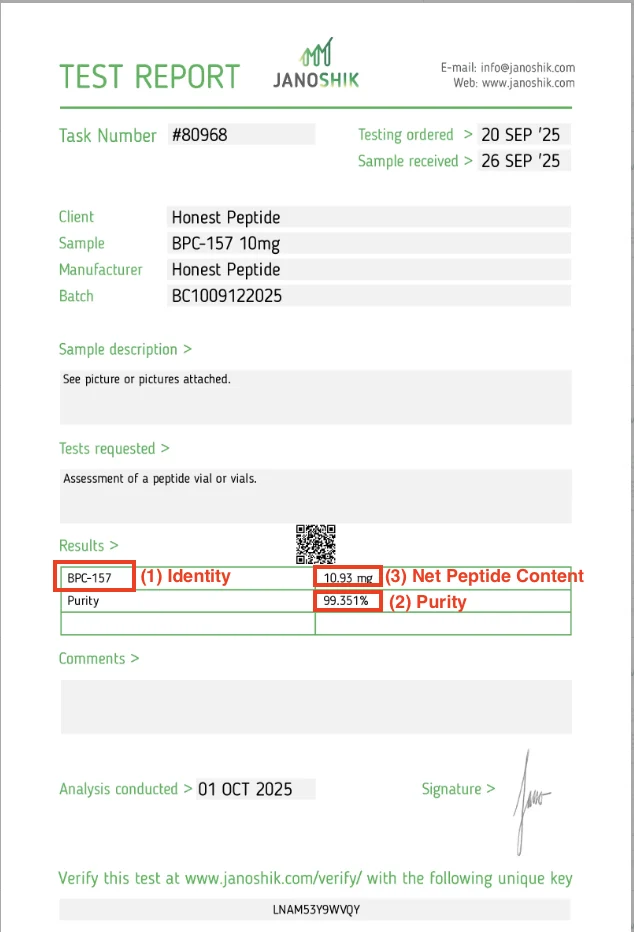
The software attracts borders around each top and determines the area below. The purity percent originates from comparing the area of the major optimal to the overall location of all discovered optimals. The majority of reports consist of a table listing each top's retention time, location, and percent of total location.Certificates Of Analysis: How To Review And Translate Lab Reports
The quality and reliability of a peptide pureness dimension rely on approach criteria and paperwork top quality. The mobile phase, commonly a blend of water, acetonitrile, and an acid modifier, is kept in tanks and provided through the system by a high-pressure pump. The pump maintains specific flow prices, typically in the series of 0.5 to 2.0 mL/min relying on the approach and column format. High pressure requires the mobile stage through securely loaded particles inside the column, creating sharper splittings up and greater resolution than standard low-pressure chromatography.- Evaluating allows scientists to comprehend precisely what remains in the vial, verifying both identification and quality.Ensuring that each batch goes through proper laboratory screening helps verify the peptide's credibility and pureness, which is vital for both research study credibility and safety.We can provide expert peptide pureness resolution solutions using analytical reversed-phase HPLC paired with mass spectrometry.Not every application demands 99% purity, and purification is a significant element of peptide production cost.
BOC Sciences, with its durable logical system and expert group, concentrates on high quality screening solutions for peptide basic materials, peptide microspheres, peptide nanoparticles, and peptide formulation preparations. We work with biotech, pharmaceutical, CRO, CDMO, and scholastic groups on peptide chemical and physical analyses that support research study and non-clinical decision making. Contact us today to review your peptide series, example standing, and analytical objectives.
Mass Spectrometry (ms): Identity Confirmation
Relied on labs use tested screening protocols to assess peptide examples and confirm their pureness and chemical make-up. One core technique is High-Performance Liquid Chromatography (HPLC), the Biochemistry gold criterion for examining peptide pureness. HPLC separates peptide blends and can spot even small contaminations listed below 1% of the sample [4] A common laboratory will run the peptide through an HPLC system and produce a chromatogram-- the primary optimal corresponds to the target peptide, and any kind of additional optimals indicate other compounds. The pureness is then quantified as the percent of the main peak location versus overall areas, giving an accurate step of exactly how pure the peptide is [2]
Perk Components (marks Of A Top Quality Vendor)
By insisting on peptides that include confirmation of purity and identity, researchers can substantially reduce the danger of speculative artifacts. Conversely, using peptides that have actually passed third-party lab validation helps guarantee that the observed speculative effects are genuinely as a result of the intended peptide and not because of pollutants or errors. When you see peptides marketed as "research-grade," it refers to their intended use and the level of making oversight. Research-grade peptides are made for research laboratory research use just-- they are not created under pharmaceutical GMP criteria and are not suggested for use as therapies or in human beings. These peptides come with a basic quality control plan, generally consisting of HPLC pureness analysis and MS verification of identity, guaranteeing they fulfill clinical standards for pureness and make-up.